



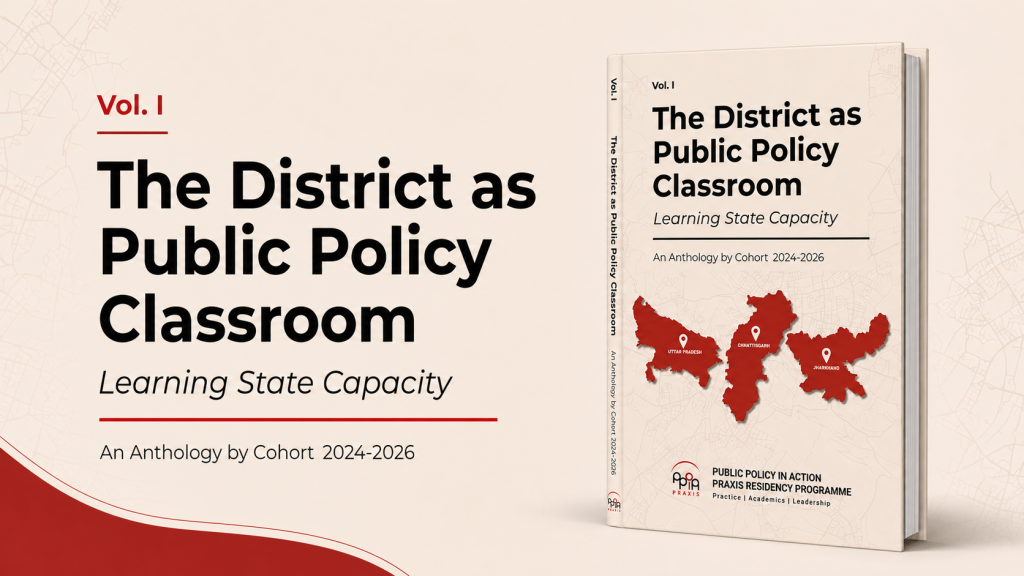
The premise for this anthology is straightforward, even if testing it is not: if the district administration is the unit through which government programmes are delivered, can it also be the classroom in which young professionals learn the fundamentals of governance and public policy? Not by studying the district from outside, but by working inside it, strengthening its systems while a structured cycle of in-person and virtual sessions helps them place what they are learning within the wider academic and policy discourse.
Ten young professionals were placed across ten districts of Jharkhand, Chhattisgarh, and Uttar Pradesh—districts chosen for being resource-challenged, and deliberately not the home districts of the learners themselves. Each brought roughly two years of prior experience across an eclectic range of work in research and development, and in the social policy space more broadly. For two years, the district was to be their subject of study, not as an administrative unit alone, but as a socio-cultural and economic entity in its own right.
Most of these learners had lived or worked in metropolitan cities before this. They were now embedded in district administrations—some transferred mid-way for operational reasons—working on public health, livelihoods, and other thematic areas.
This anthology gathers their accounts of what that embedding taught them: about India’s permanent executive, about the district as a vantage point for understanding development, and about what it actually takes, in practice, to make the public system accessible to the marginalised citizen.
